
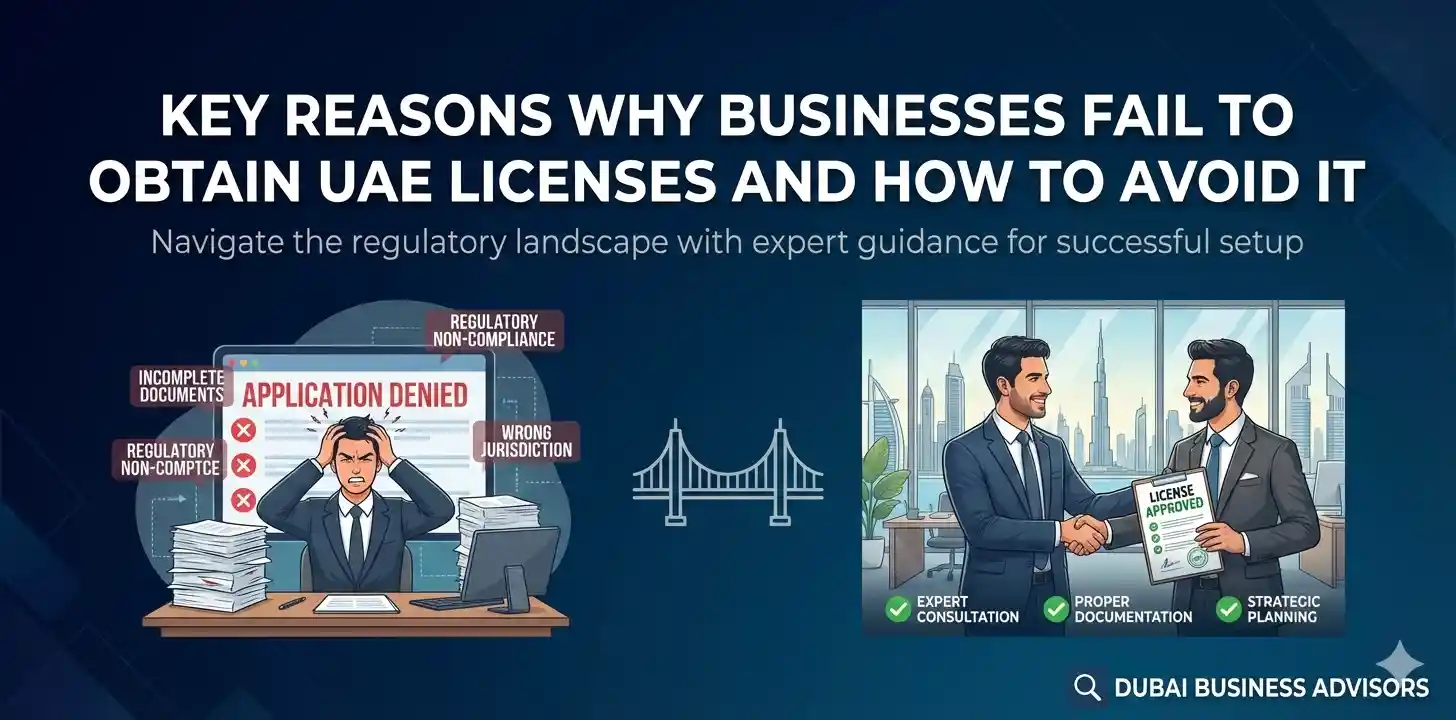
Every year, the UAE sees a massive surge in new business registrations, with thousands of entrepreneurs entering the market. Dubai alone has issued over 45,000 new trade licenses in recent years, highlighting just how strong and competitive the business ecosystem has become.
While the licensing process may appear straightforward at first glance, many applications face unexpected delays or rejections. In most cases, this has nothing to do with the business idea itself. Instead, small mistakes, incorrect license selection, or overlooked requirements become the real obstacles.
For first-time founders, especially, the strict regulations of Free Zone and Mainland authorities can come as a surprise, and even a minor mismatch in documentation or activity can slow down or stop approval altogether.
This guide talks about why businesses fail to obtain UAE licenses and what you can do to prevent rejection, according to our business consultants in Dubai.
Why UAE Business License Applications Get Rejected?
UAE authorities focus on transparency and compliance. Some of the applications fail mainly because the details do not match the official requirements. Take a look at some of the major reasons.
Choosing the Wrong Business Activity
Business activity selection is the foundation of your license. The authorities approve licenses based on the exact activity you choose.
Examples of mismatches include:
- Selecting general trading for an online store
- Choosing a consultancy for marketing services
- Applying for food trading instead of restaurant operations
Each activity falls under a specific license category such as commercial, professional, or industrial. If the activity does not match your actual work, approval stops immediately.
Many Indian founders also choose activities based on cost or speed rather than accuracy. That decision often leads to rejection.
How to avoid this issue?
Decide on your core service or product first. Match it with the official activity list of the Free Zone or Mainland authority. A correct activity saves time and future legal trouble.
Selecting an Incorrect Free Zone or Mainland Area
Each Free Zone supports only certain business types. Mainland licenses also have different rules.
Some of them include:
- Applying for a physical shop license in a Free Zone.
- Choosing a Free Zone that does not allow your activity.
- Ignoring special approvals needed for regulated sectors.
Examples of zone preferences:
- Dubai Free Zones suit branding and international reach
- Ajman Free Zone works well for low-cost trading
- Sharjah Free Zone supports storage and logistics
- RAK Free Zone suits small traders and exporters
- IFZA supports service-based businesses
A mismatch between zone rules and your activity leads to rejection.
How to avoid this issue?
Check zone activity limits before applying. Pick the area that officially supports your business model.
Passport Problems & Document Errors
Your passport is the most critical document in the application. Authorities carefully verify passport validity and clarity.
Some of them include:
- Passport validity is less than six months
- Blurred or cropped scans
- Name spelling differences
- Old passport details
Free Zones like IFZA, RAK, Ajman, and Dubai Free Zones strictly review passport files before moving the application forward.
How to avoid this issue?
Make sure that your passport is valid for at least six months. Next, upload a clear, full-page scan. Update spelling errors before the submission.
Name Spelling Mismatch Across Documents
Many rejections happen due to spelling differences between documents. Authorities require exact matching.
Examples of mistakes:
- Kumar vs Kummar
- Mohammad vs Mohammed
- Missing middle names
Once approved incorrectly, these issues can affect visas, Emirates ID & bank accounts.
How to avoid this issue?
Use the exact spelling from your passport everywhere. So, double-check forms/applications/ payment receipts.
Applying for Restricted Activities Without Approval
Certain activities need approval from additional authorities.
Examples include:
- Medical and healthcare services
- Fitness and yoga training
- Education and training institutes
- Food and restaurant businesses
Skipping these approvals leads to instant rejection.
How to avoid this issue?
Identify if your activity needs any special permission. Complete authority approvals before submitting your license application.
Incomplete/ Incorrect Payment Process
Each authority has a unique payment structure. Incomplete payments stop the application automatically.
- Paying the wrong amount
- Missing transaction references
- Using any unsupported payment modes
Some zones also accept online payments, while others require bank transfers.
How to avoid this issue?
Follow the official payment steps very carefully. Confirm receipts and references before submission.
Submitting Any Incorrect Business Information
Some founders might use temporary addresses, or false activity descriptions to speed things up. However, UAE systems detect these things very quickly than you can imagine.
Any minor Incorrect details can result in delays and future compliance issues.
How to avoid this issue?
Always submit accurate information. Honest details ensure faster approvals and smooth renewals.
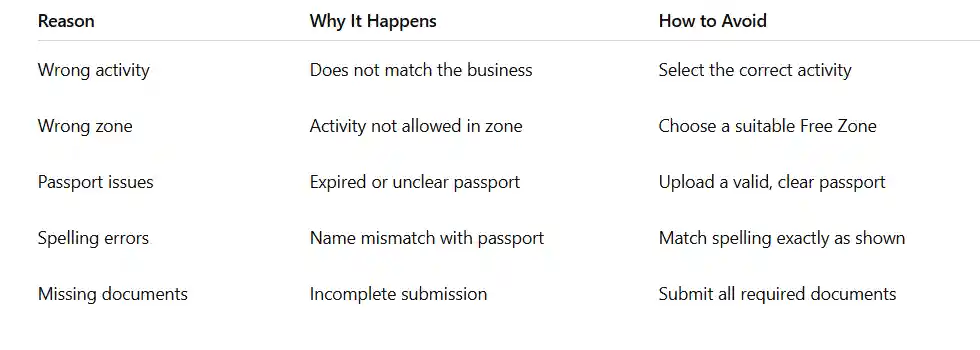
Common Reasons for UAE License Rejection and Solutions
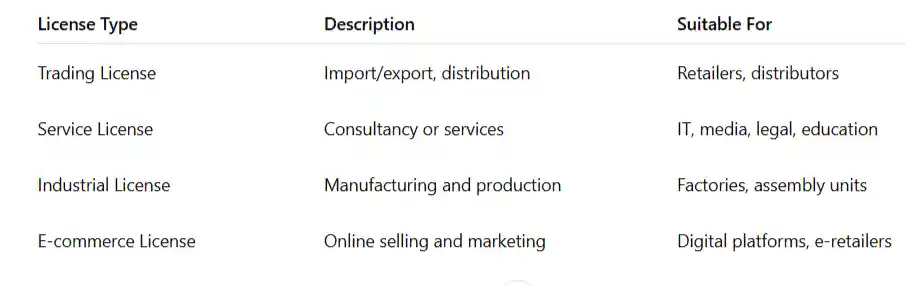
Key Licensing Types Across UAE Free Zones
Take a look at the major license type and the businesses it comes under
How to Avoid Rejection While Applying for a UAE Business License
Many entrepreneurs worry about license rejection, especially when applying from outside the UAE. But the process can be smooth and handled with ease when each step is handled correctly.
Step 1: Select the Right Business Activity
Match your actual work with the official activity list.
Step 2: Choose the Correct Zone ( Major Step)
Make sure the Free Zone/Mainland supports your activity.
Step 3: Verify the Passport Details
Maintain six-month validity & clear scans.
Step 4: Match The Name Spellings
Keep the spelling identical across all documents.
Step 5: Complete Required Approvals
Get authority permissions where required.
Step 6: Follow Payment Instructions correctly
Complete the payments. ( using approved method).
Step 7: Submit Accurate Information
Use only real & verifiable business details.
Conclusion
UAE business licensing can be a bit confusing. Most of the rejections happen due to avoidable errors rather than complex rules. Careful planning, correct documentation, and the zone selection make the process smooth.
A well-prepared application can save your time reduces costs, and allows businesses to start operations faster. With the right guidance and attention to detail, obtaining a UAE business license becomes a simple and reliable process.
So, ready to get your approvals ready?. Talk to Damaar Business Setup Consultants and start your UAE business the smart way