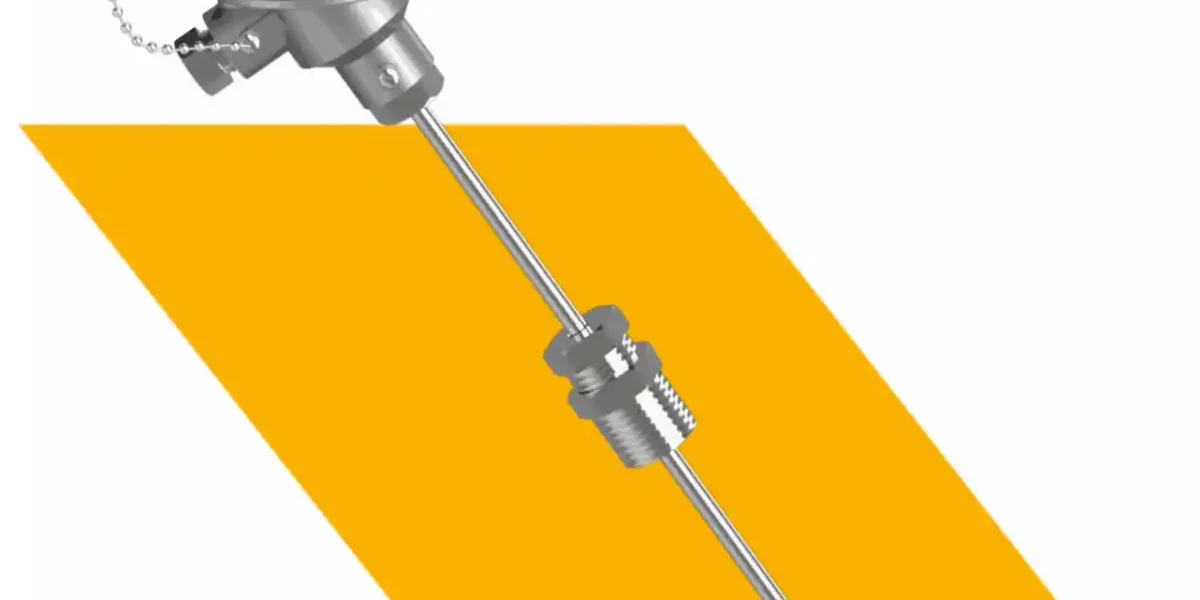
Picking a sensor supplier sounds like a small decision until something goes wrong on the plant floor. A resistance temperature detector that drifts out of calibration, fails inside a thermowell, or simply doesn’t fit the process conditions can throw off an entire control loop. That’s why choosing the right resistance temperature detector manufacturer deserves more thought than comparing a few data sheets and picking whichever one arrives fastest.
What an RTD Manufacturer Supplies
A resistance temperature detector works on a fairly simple principle. As temperature rises, the electrical resistance of a conductor increases in a predictable, near-linear way. The sensor measures that change in resistance and converts it into a temperature reading. What sounds simple in theory gets complicated in practice, because the same basic principle has to hold up inside a corrosive tank, a vibrating bearing housing, or a high-pressure pipeline.
A capable manufacturer supplies the full assembly: the platinum element itself, the lead wire configuration, the sheath material, the thermowell or protection tube around it, and often the calibration paperwork that proves the sensor performs the way it claims to. Tempsens, for example, builds its RTD range around platinum elements calibrated to standards such as DIN 43760 and IEC 751, paired with sheath and thermowell options suited to different pressure, corrosion, and vibration conditions.
Key Factors to Evaluate Before Choosing a Manufacturer
1. Range of RTD Types and Configurations
Not every application needs the same RTD. Some need a simple 2-wire configuration for basic monitoring, while others require 3-wire or 4-wire setups to cancel out resistance errors introduced by long lead wires. A manufacturer that only stocks one configuration will end up forcing a compromise on your process rather than fitting the sensor to it. Look for a supplier offering the full spread: 2-wire, 3-wire, and 4-wire RTDs, so the configuration is chosen based on your accuracy needs, not on what happens to be in stock.
2. Sheath and Construction Quality
The sheath is what stands between the sensing element and whatever the process throws at it: pressure, chemical exposure, mechanical shock, or vibration. Mineral insulated RTDs, where the platinum element sits inside a sealed metal sheath filled with compacted insulation, tend to hold up well in tight or vibration-prone installations because of how compact and shock-resistant the design is. A manufacturer worth considering should be able to explain, in specific terms, why a given sheath material or construction fits your process rather than offering a generic “it works fine” answer.
3. Certifications and Calibration Traceability
ATEX and IECEx certifications matter if the sensor will sit in a hazardous or explosive atmosphere. CE marking signals conformity with relevant regional standards. NABL accreditation points to calibration traceability, meaning the sensor’s accuracy can actually be verified against a recognized reference rather than taken on faith. A manufacturer that holds these certifications across its range gives a plant documentation it can lean on during audits and safety reviews.


4. Thermowell and Protection Tube Options
An RTD rarely sits exposed directly in a process stream. A thermowell, a closed-end metal sleeve, sits between the sensor and the process, absorbing pressure, flow-induced force, corrosion, and erosion so the sensor itself doesn’t have to. It also allows the RTD to be pulled out and replaced or recalibrated without shutting the process down. A manufacturer offering a wide range of thermowells and protection tubes, matched to different pressure ratings and materials, gives a plant more flexibility to swap sensors during scheduled maintenance rather than during an unplanned outage.
5. Application-Specific Engineering Support
General-purpose RTDs work fine for straightforward monitoring, but some environments need something more tailored. Bearing temperature monitoring, transformer winding measurement, and nuclear-grade sensing all call for RTDs built around the specific mechanical and thermal demands of that use case. A manufacturer that can walk through these special-purpose designs, rather than pushing a standard catalog part into an application it wasn’t built for, tends to save a plant from repeat failures down the line.
Common RTD Configurations to Look For
● Lead Wire Configurations
As mentioned, 2-wire, 3-wire, and 4-wire designs each suit different accuracy requirements. Longer cable runs generally call for 3-wire or 4-wire configurations, since these compensate for resistance in the lead wires themselves, which would otherwise skew the reading.
● Mineral Insulated RTDs
These combine a flexible, compact build with strong shock resistance, which makes them useful in tight spaces where a bulkier probe wouldn’t fit or would be prone to vibration damage.
● Platinum RTD Sensor Ranges
Platinum RTDs are typically available in a few standard resistance values — Pt100, Pt500, Pt1000, and Pt5000 — each suited to slightly different measurement and transmitter requirements. Tempsens offers all four of these across its platinum RTD line, giving engineers flexibility depending on the signal conditioning equipment already in use at a facility.
● Special-Purpose RTDs
For niche applications such as bearing surfaces, transformer windings, or nuclear facilities, standard probe designs often don’t fit the mechanical constraints involved. Purpose-built RTDs designed around these specific mounting and exposure conditions tend to perform more reliably than a generic sensor squeezed into an unusual space.
Questions Worth Asking Before You Commit
A few direct questions can reveal a lot about a manufacturer’s actual capability.
- Does the temperature range on offer cover your process, keeping in mind some RTDs are rated from as low as -200°C up to 850°C?
- Can they provide calibration certificates traceable to a recognized standard?
- Do they offer application-specific engineering advice, or only a catalog of fixed parts?
A manufacturer that answers these clearly, with specifics rather than vague reassurances, is usually one worth working with.
Final Thoughts
Choosing a resistance temperature detector manufacturer isn’t just about finding the lowest price on a sensor that technically measures temperature. It’s about finding a supplier that understands lead wire configurations, sheath materials, thermowell design, and certification requirements well enough to match a sensor to your exact process rather than the other way around. Getting this choice right at the start saves a plant from replacing sensors more often than necessary and from chasing measurement errors that trace back to a mismatched component in the first place.
Related Reading: Путь игрока от клика до повторного депозита: что анализирует traffic-команда — full guide
Related Reading: Quick Dishwasher Fault Repair — full guide